


Wearable Tech Is Rewriting the Rules of Travel, and Helping Tourists Stay Off Their Phones
December 4, 2025
- Wearables are reshaping travel, with AR glasses, smartwatches and earbuds edging toward a screen-free experience. But experts say today’s tools remain fragmented, with translation, navigation and payments still operating in separate silos.
- Interoperability and trust are the core barriers. IEEE members say travelers won’t rely on wearables as passports or wallets until devices offer week-long battery life, offline capability, universal privacy standards and AI that is “never wrong” in critical moments.
- Haptics and AR could redefine how travelers receive information, from wristbands guiding blind users through vibration patterns to glasses providing live captioning. But experts agree technology should enhance, not replace, the sensory experiences that make travel meaningful.
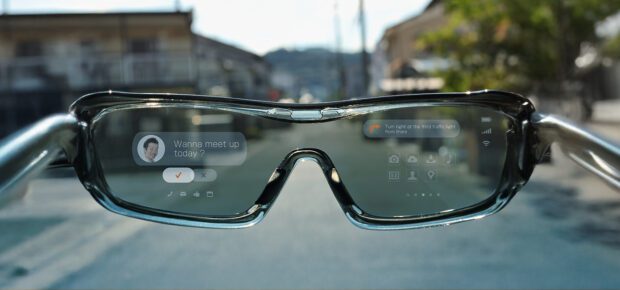
You can tell the future of travel is arriving not by what people are holding, but by what they’re wearing. Glasses that whisper cultural cues, watches that navigate through haptics, earbuds that quietly translate conversations: the screen is disappearing, but the tech is more present than ever.
Wearables are changing the rules of travel, allowing tourists to translate foreign languages and navigate foreign cities, all without touching their phone. The building blocks are already here: smart glasses that recognize landmarks, earbuds that translate conversations in real time and digital wallets that handle everything from boarding passes to shopping. But these tools don’t yet work together as one system.
“The ‘silos’ between services remain the biggest hurdle,” said IEEE Member Man Zhang.
Breaking those silos, Zhang said, requires breakthroughs in application programming interfaces integration, user data privacy protocols and, most importantly, creating AI agents that are 100% reliable.
“We are probably five to 10 years away from this being a mainstream, trustworthy reality,” she noted.
The Missing Pieces: Power, Integration, Trust
Tourists have relied on digital technology to ease the burdens of travel for years. Map apps in your smartphone can help you navigate a city and use public transportation. Translation apps can handle menus and basic conversations. Contactless payments now work in most major cities.
As IEEE Member Ning Hu points out, the experience is still fragmented. Wearables do some of these things, but they all require connection to a smartphone, and most of them still require specific apps to run the device.
Real-time translation suffers from noticeable latency and struggles with accents and contextual nuances. Contactless payment systems are widely adopted but remain fragmented across regions. GPS is strong outdoors, but indoor navigation and contextual guidance still lag significantly. Safety tools exist, but they are not well integrated or predictive.
“The missing pieces extend beyond technology itself,” Hu said. “We need interoperability and trust. Universal standards are essential, and travelers must have confidence that these systems won’t fail at critical moments. This requires addressing cross-regional compliance and data privacy concerns.”
For wearables to become as dependable as a passport or wallet, Hu argues that five breakthroughs are key: week-long battery life, robust offline capability, contextual AI that understands when and how to interrupt, an international privacy and identity framework and devices durable enough to survive water, drops and temperature extremes.
Zhang sets an even higher standard for reliability.
“We trust our passports and wallets because they are simple and don’t fail,” she said. “If your digital passport app has a bug at border control, or your payment system fails in a taxi, the technology becomes a liability, not a help. This level of trust requires AI that is not just ‘mostly right’ but ‘never wrong’ in critical situations.”
While it may not always be seamless, wearables are already on the market and are being used by travelers.
“We are already there. The technology is available to anyone, but it is not yet widely adopted,” said IEEE Life Fellow Stu Lipoff, who uses smart glasses connected to his phone when he travels.
He already relies on voice commands to get directions and translate foreign text. He can ask, “What am I looking at?” through the camera and call for emergency help. The catch, he says, is that “the applications are not seamless and you need to learn to use them.”
Augmented Reality and Haptics: Information Without the Screen
Where many experts see the biggest change is in how information reaches travelers’ senses.
“Haptics enables sensory substitution and liberation, freeing individual senses from dedicated tasks so they can be redirected to richer experiences,” said Hu. Instead of staring at a map, a traveler could feel a vibration pattern that signals a left or right turn. Eyes stay on the street, ears stay with companions and devices will tell people how to navigate through discreet signals they can feel.
Zhang imagines systems that help blind travelers with a combination of camera, AI and haptics, maybe in a wrist band, to signal turns or obstacles. For deaf travelers, AR glasses could provide real-time, live captioning of a tour guide’s speech
In Brazil, lEEE Senior Member Cristiane Pimentel points to immersive projects that let blind visitors feel and hear the Iguazu Falls through sound and vibration. She expects wearables to become more aesthetically pleasing, more resilient to heat and humidity and eventually replace printed guides and even some physical information displays at tourist sites.
What Should Never Be Automated Away
Despite their optimism, the experts draw a line on what travel tech should not replace.
“Technology should never replace the unfiltered, spontaneous sensory experience of tasting local food,” said Zhang, describing the experience of sitting in a Hanoi market with a bowl of phở as irreplaceable.
The future these experts describe is not one of flashy gadgets for their own sake, but of quieter, more ambient tools. If they’re right, the most advanced travel tech will be the gear you barely notice, because you’re too busy paying attention to the place you came to see.
Go Deeper: Seamless travel depends on constant connectivity, but today’s internet has limits. It can transmit sound, images, even haptic feedback that mimics touch, but not yet the full sensory range of experience. In a recent IEEE Spectrum article, IEEE Life Fellow Vinton Cerf, co-inventor of the internet, and IEEE Senior Member Mallik Tatipamula explore the coming “Internet of the Senses,” a network capable of conveying texture, temperature and even scent.
Interested in becoming an IEEE member?

Ning Hu
IEEE MemberZhang Man
IEEE MemberCristiane Agra Pimentel
IEEE Senior MemberStu Lipoff
IEEE Life FellowRelated Stories




 Meaningful Momentum or Running in Place?
 AI Through Our Ages
 Liquid Infrastructure: Our Planet's Most Precious Resource
 The Impact of Technology in 2025
 Quantum and AI: Safeguards or Threats to Cybersecurity?
 Why AI Can't Live Without Us
 Bits, Bytes, Buildings and Bridges: Digital-Driven Infrastructure
 Impact of Technology in 2024
 Emerging AI Cybersecurity Challenges and Solutions
 The Skies are Unlimited
 Smart Cities 2030: How Tech is Reshaping Urbanscapes
 Impact of Technology 2023
 Cybersecurity for Life-Changing Innovations
 Smarter Wearables Healthier Life
 Infrastructure In Motion
 The Impact of Tech in 2022 and Beyond
 Cybersecurity, Technology and Protecting Our World
 How Technology Helps us Understand Our Health and Wellness
 The Resilience of Humanity
 Harnessing and Sustaining our Natural Resources
 Creating Healthy Spaces Through Technology
 Exceptional Infrastructure Challenges, Technology and Humanity
 The Global Impact of IEEE's 802 Standards
 Scenes of our Cyber Lives: The Security Threats and Technology Solutions Protecting Us
 How Millennial Parents are Embracing Health and Wellness Technologies for Their Generation Alpha Kids
 Space Exploration, Technology and Our Lives
 Global Innovation and the Environment
 How Technology, Privacy and Security are Changing Each Other (And Us)
 Find us in booth 31506, LVCC South Hall 3 and experience the Technology Moon Walk
 Virtual and Mixed Reality
 How Robots are Improving our Health
 IEEE Experts and the Robots They are Teaching
 See how millennial parents around the world see AI impacting the lives of their tech-infused offspring
 Take the journey from farm to table and learn how IoT will help us reach the rising demand for food production
 Watch technical experts discuss the latest cyber threats
 Explore how researchers, teachers, explorers, healthcare and medical professionals use immersive technologies
 Follow the timeline to see how Generation AI will be impacted by technology
 Learn how your IoT data can be used by experiencing a day in a connected life
 Listen to technical experts discuss the biggest security threats today
 See how tech has influenced and evolved with the Games
 Enter our virtual home to explore the IoT (Internet of Things) technologies
 Explore an interactive map showcasing exciting innovations in robotics
 Interactively explore A.I. in recent Hollywood movies
 Get immersed in technologies that will improve patients' lives